Call Us: 772-924-1055 e-mail: bob@massageonthemove.com



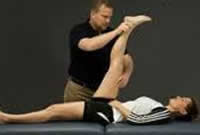 Active Isolated Stretching (AIS) is one of the more popular methods of stretching used by today's athletes, massage therapists, personal and athletic trainers. The AIS method differs from other types of stretching and strengthening programs in several important respects. Paraphrased from an article by Dr. Ben Benjamin, Ph.D. and listed below are 7 characteristics of the AIS method. Each is supported by established principles of human physiology. Note that although this method is called Active Isolated Stretching, it actually incorporates both stretching and strengthening in almost every maneuver. The AIS technique involves the method of holding each stretch for only two seconds. This method of stretching also works synergistically with the body to improve circulation and increase the elasticity of muscles, connective tissue, and fascia.
AIS movements are targeted to stretch individual muscles and parts of muscles, rather than larger muscle groups. (For instance, in contrast to a simple forward bend that provides a general stretch for all aspects of the hamstring muscles, AIS uses six different stretches to focus on different combinations of the medial, lateral, oblique, proximal, and distal fibers.) There are AIS protocols for every primary muscle in the body, amounting to more than 170 separate stretches. Using customized combinations of stretches, we can develop regimens specific to the needs and goals of our clients.
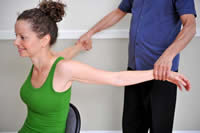 Most of the work done during an AIS session is done by the client. The stretches are initiated by the client once we have done the set up to isolate the targetted muscle, and it is the client that takes the stretch to the limit of their range of motion. Using the principles of Reciprocal Inhibition - when muscles on one side of a joint are contracted (agonist), the muscles on the other side of the joint (antagonists) will relax - by having the client initiate the contraction, we are able to acheive a more thorough stretch of the now relaxed antagonist muscle. Plus, the active engagement of the muscle by the client will cause the muscle and surrounding fascia to warm (aerobic glycolysis), promoting and even greater flexibility during the session.
Each time our client's reach the end of their active range of motion, we provide a small amount of force to push slightly beyond what the person could do on their own. In this way it’s possible to increase flexibility incrementally, by adding only two or three degrees to the end of each repetition.
The movements involved in AIS are very gentle, rarely exceeding 50% of a muscle’s maximum sustainable force (i.e., the level of force that will cause that muscle to "break"). This type of motion also helps to delay activation of the myotatic reflex (commonly referred to as the stretch reflex) — the body's defense mechanism for preventing a muscle from stretching too far or too fast by casing the muscle "at risk" to reflexively contract.
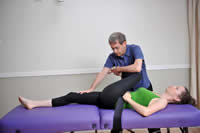 Avoiding the stretch reflex altogether can be accomplished by holding a stretch for no more than 2 or 3 seconds. Historically, exercise physiologists, physical therapists, and personal trainers have recommended holding stretches for up to 60 seconds and no less than 30 seconds. This method, known as static stretching, has been shown to initiate the stretch reflex, resulting in decreases blood flow within the tissue, and a buildup of waste products, such as lactic acid, that contribute to short term muscle fatigue and soreness. The reflex induces a contraction of the very muscles they’re trying to lengthen (like driving a car with one foot on the gas and the other on the brake). As a result, tendons and ligaments are stretched more than the muscles. This can certainly lead to inflammation of the connective tissue or laxity from over-stretching which predisposes these already vulnerable tissues to injury.
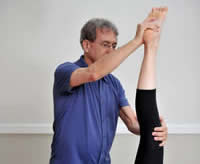 Static stretching relies on a principle known as stress relaxation: when muscles and connective tissues are held at a constant length for a prolonged period (30-60 seconds for example), they eventually fatigue, release, and lengthen. This fairly slow method relies on that muscle fatigue to acheive the desired result. As we stated in 4 & 5 above, forcing a prolonged passive stretch stimulates the mechanorecptors in the muscle resulting in the activation of the stretch reflex which is usually counter-productive relative to the goals of the session. AIS achieves results much more quickly by using 6 to 10 repetitions of shorter duration stretches (2-3 seconds). This method can help increase the range of motion in a particular area by as much as 60 degrees in a much shorter period of time.
During an AIS session lasting between 30 and 60 minutes, we encourage our clients to coordinate movements with deep, relaxed breathing. This helps to increase the flow of oxygen to muscles, decrease fatigue, and encourage release of tension and fascial bunching. Breath holding should be avoided since, with oxygen available, muscles burn fatty acids and glucose(aerobic metabolism). When sufficient oxygen is not available, glucose gets metabolized into lactic acid (anaerobic metabolism), again leading to muscle fatigue and soreness DURING THE SESSION. A note here on Lactic Acid, long believed to be the cause of DOMS (Delayed Onset Muscle Soreness - that next day soreness). Recent evidence suggests that the body flushes Lactic Acid from the muscles within 30-60 minutes and that DOMS is the result of microscopic tears of the muscle fibers. The discomfort felt a day or two following intense exercise is actually the healing process of those micro-tears. Lactic Acid fatigue is short lived unless the anaerobic conditions are sustained over times - we observe this as "bonking" or "hitting the wall" during endurance events for example. Lactic Acid glycolysis is much less efficient as an energy producer than the burining of glucose or fatty acids in the mitochodria of the muscle cells.
Monday-Friday 8:30 AM - 7:30 PM Saturday* 8:30 AM - 2:30 PM Sunday* - Closed with Exceptions Call 772-924-1055
* Weekend Hours subject to change based on Scheduled Events at which we are working - Private Parties, Sports Events Fundraisers, or Special Events.
Refer Three and Yours is Free! For every three new clients you refer, receive an e-gift certificate for a FREE 30 minute Swedish Massage (or equivalent) NO LIMITS