Call Us: 772-924-1055 e-mail: bob@massageonthemove.com



 The treatment of chronic Pain has historically been difficult using the traditional western medical model. Drugs & surgery may be effective with managing some conditions, but with many complex lifestyle pain syndromes, such as back pain, fibromyalgia, migraines etc. the elimination of or long term management of Pain has been elusive at best. Understanding and dealing with complex or even general pain disorders is something Medical/Therapy schools do not adequately prepare their students to address in real world situations. Unfortunately, there are no courses entitled Pain Management 101 in western medicine.
ETPS is an FDA approved therapy that combines the principles of acupuncture & neurology with microcurrent stimulation.
The handheld ETPS unit applies concentrated DC micro-stimulation through its stylus shaped tip to produce an “acupuncture-like” response that “releases” muscle tissue may either be impinging on nerves or otherwise causing pain locally or at joint articulations. This action permits increased reinnervation of affected neural pathways, allowing patient pain levels to be substantially decreased, often in the timeframe of the session itself. This multi-pronged approach to the body’s nervous and musculoskeletal system is the reason why ETPS works so well on pain. Clinically, the intention of ETPS is to isolate the root causes of a patient’s pain by applying micro-stimulation to acupuncture points that relate to different muscles, tissues and systems (neurological, segmental, limbic, myofascial etc).
Based upon clinical trials and research, it is believed that the following seven areas are directly responsible or significantly control all pain conditions, regardless of the symptoms.
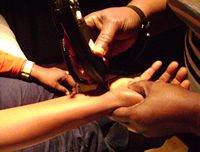
The application of ETPS to select acupuncture points in the wrist and ankles can significantly calm the nervous system, reduce anxiety, relieve muscle tension, and diminish pain levels. The singular point H7 (Heart 7) has such a strong relaxing effect on the body that its Chinese name “Shenman” - literally translated to “body relaxer”. The effects of H7 are similar to some pharmaceutical products but without negative side effects. Treatment of this point alone can reduce, within minutes, over all muscular tension 50-70%, promoting relaxation and reducing guarding.
The Key to the treatment of almost all chronic pain syndromes is the deregulation (or calming) of the autonomic nervous system, and the release of physical/mental blockages which seem to keep the ANS in “high” gear. Upregulation of the Autonomic Nervous System (ANS upregulation is also called hypersensitivity) may be caused by nerve root entrapment, called radiculopathy, misalignment of the spine or mandible, emotional stress such as anxiety or apprehension, or scars which innervate or energetically influence (through the acupuncture meridians) areas of the body not necessarily local to the scar itself. In order to calm the patient and relax their muscles and reduce apprehension, there are several well known potent parasympathetic acupuncture points, located on the wrists and top of the head that significantly reduce the sympathetic nervous system, calming the patient, reducing muscular tension, and permitting deeper manual tissue work without patient guarding.
This technique involves applying ETPS to each side of visible scars with microcurrent therapy in order to “repolarize” the local tissue and release fascia and muscles which are influenced by the scar. You should not underestimate the potency of scar release and the effects that it has in restoring the communication pathways of the body. Releasing scars involved with meridians and dermatomes that influence both local and remote (referred) pain sites can sometimes be the single most important factor in the treatment of chronic pain. The common culprits in women are scars in the front torso, and for men scars on the extremities.
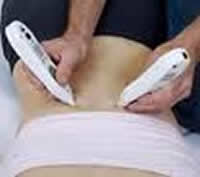 Entrapment of the nerve root will have significant influence on or cause pain along the nerve pathways (dermatomes). Nerve roots get pinched when the paraspinal muscles shorten and compress the roots. This is often due to poor lifestyle, ergonomics, traumatic injuries or congenital factors. The tissues and organs innervated by that nerve root will be adversely effected and abnormally functioning on a proportional basis. This is Cannon’s Law of Dennervation, and the law states; “any measure that reduces the flow of motor impulses will cause abnormal functioning in the receptor organ or tissue”. A 50% nerve root impingement will cause 50% reduction in orthopedic functioning of the joint. Unfortunately, a person may remain asymptomatic until radiculopathy reaches 70% or greater. Radiculopathy is the main reason why many physicians inject the paraspinal muscles with pain suppressive drugs and cortisone. Applying ETPS to the muscles on each side of a pinched nerve will immediately relax the paraspinal muscles and “release” the nerve root entrapment, providing significant relief to the suffering patient. Every ETPS session begins with a standard protocol sequence - both on the low back and neck for upper limb pain, and low back alone for leg pain. Prior to the application of the ETPS an manual realignment of the hips is performed to equalize leg length.
The sacrum is the foundation of the spine and sits at its base. The spine, through nerve root impingement influences many pain conditions, so when the sacrum is out of alignment there is usually a "ripple effect" up the spinal column. Tightened muscles, especially around the lower back and beside the sacrum (buttock muscles) can misalign the entire skeletal system by rotating the sacrum. The sacrum projects significant influence on the pain cycle as it directly influences the parasympathetic nervous system, which counter-acts the pain cycle (sympathetic nervous system). Many chronic disorders, such as back pain, knee pain, fibromyalgia/chronic fatigue, to name just a few, have significant pain origins in the spine/sacrum. Relaxing the muscles in the lower back and around the sacrum help “realign” the sacrum and can produce immense long term benefits to the pain sufferer. As we stated earlier, every session, regardless of conditions or symptoms, begins with ETPS being applied to the lower back and buttocks (piriformis & gluteus medius muscles).
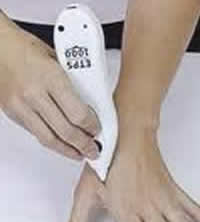 Traditionally, acupuncture is the number one modality for the treatment of pain and disease on a global basis. It has been employed for almost 5000 years and has been researched in depth to establish its clinical applications. There are many powerful pain relief points throughout the body, but many of the particularly potent ones are found in and around the hands and feet. Points in the hands & arms influence head and face pain. Upper meridians influencing the face originate in the hands and can be quickly treated with ETPS microtherapy for relief of pain the facial region. Li4 (Liver 4), Tw3 (Triple Warmer 3), and traditional “Jing” points located at the tips of the fingers and toes, usually at the root of the nail, are very potent tools for relief pain and, in the case of the toe Jing points, the release of tight muscles throughout the body.
Emotional conditions such as anxiety, depression, and apprehension tend to exacerbate the cycle of pain. Underlying emotional distress can and does have a negative effect on a person’s ability to cope with pain, and in some cases, may be directly related to the cause of that pain. Each organ in acupuncture supports a patho-physiological role and is related to a specific emotion. Current thinking on the subject is that once physical components of pain have been greatly lessened or eliminated, the emotional aspects of pain are much more easily accessible, and person is much more likely to release locked in emotions.
Monday-Friday 8:30 AM - 7:30 PM Saturday* 8:30 AM - 2:30 PM Sunday* - Closed with Exceptions Call 772-924-1055
* Weekend Hours subject to change based on Scheduled Events at which we are working - Private Parties, Sports Events Fundraisers, or Special Events.
Refer Three and Yours is Free! For every three new clients you refer, receive an e-gift certificate for a FREE 30 minute Swedish Massage (or equivalent) NO LIMITS